
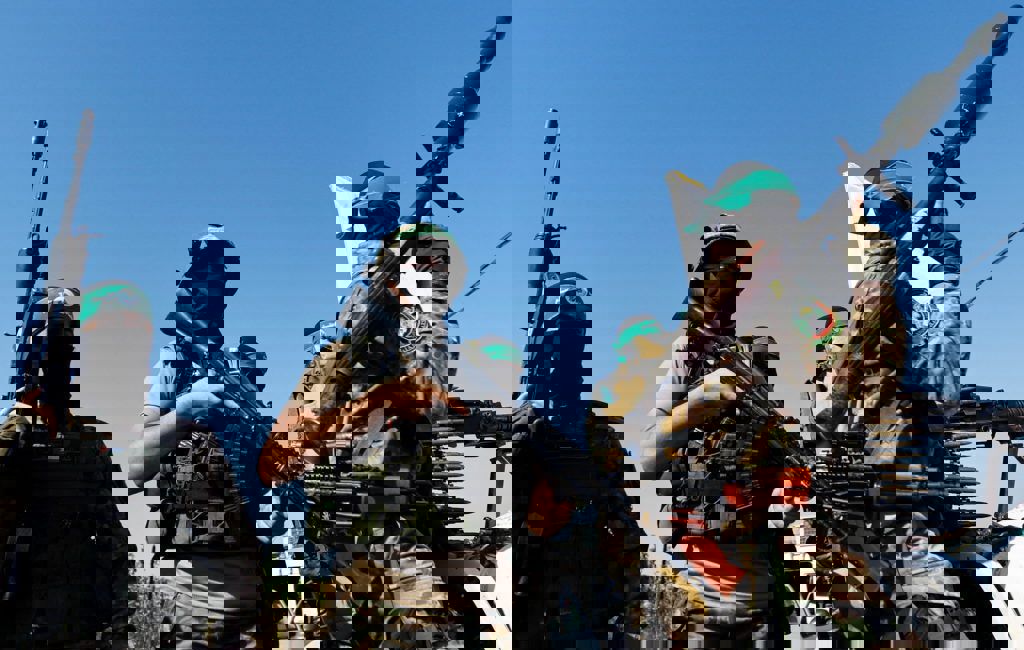
Examining a Manufactured Narrative
“During the Al-Aqsa Flood operation on October 7, the resistance did not target any hospital, school, or place of worship; It did not kill a single journalist or any member of ambulance crews”—The IDF challenges the entity to prove otherwise.
 01.01.26
 0
0
“Two years of steadfastness and the will for liberation”. This is how Hamas defines the ideology behind the last two years of their terrorism. The ‘Liberation’ they seek is further explained throughout this farcical manifesto they call their ‘Narrative’.
In a 42-page statement, the Hamas Media Team has compiled together a defence as to why they have been fighting against the IDF. Trying to reframe the October 7 Massacre as something it wasn’t, the document reads like a university club brochure, with words hand-plucked for recognition, not credibility, attempting to cover up the reality of the organization.
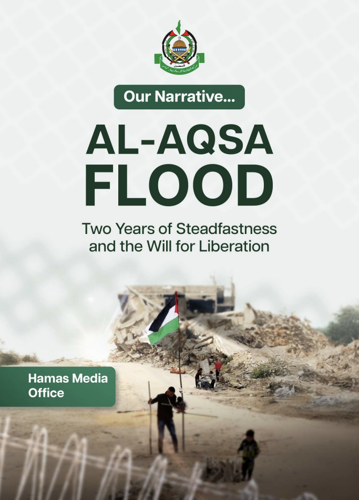
“Killing civilians is not part of our religion, morality, or education; and we avoid it whenever we can”, says the organization that invaded, murdered, and raped innocent men, women, and children in their beds.
Rather than debating competing narratives, this article examines Hamas’ own words in light of established facts, documented evidence, and Hamas’ actions before, during, and after October 7.
A Narrative Written for External Audiences
The document’s language is carefully constructed, drawing on international legal terminology, human rights discourse, and academic phrasing familiar to Western audiences. Its measured, moralistic tone is deliberately detached from the operational reality of Hamas’ actions.
This stands in sharp contrast to Hamas’ internal communications and Arabic-language rhetoric, a difference that is deliberate, reflecting a long-standing strategy of tailoring messages to different audiences.
October 7: Claims Versus Reality
In the document, Hamas describes the October 7 massacre as a calculated and legitimate military operation, portraying it as part of a broader historical struggle. It refers to the attackers as “freedom fighters” and characterizes the assault as a foundational moment that altered the region’s moral and political balance.
The facts contradict this portrayal.
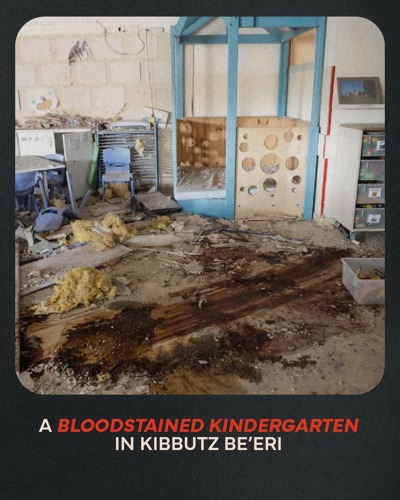
On October 7, Hamas fighters crossed into Israeli territory and deliberately targeted civilian communities. They entered kibbutzim and nearby towns, moved through residential neighborhoods, and attacked civilians in their homes. Families were murdered at close range, civilians were burned alive, women were raped, and children and elderly individuals were kidnapped. These acts took place far from military installations and cannot be credibly described as combat against armed forces.
Documents uncovered by the IDF further expose the intent behind the attack. Handwritten instructions by Yahya Sinwar, explicitly directed fighters to maximize civilian casualties through extreme violence.
“Fighters must be urged to inflict as many casualties as possible in every house, beheading, shooting heads of families, cutting off limbs… to sow mortal fear.”
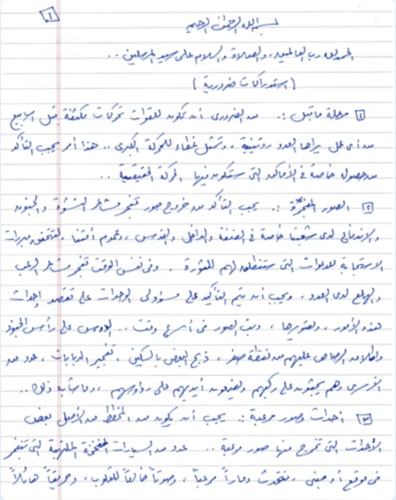
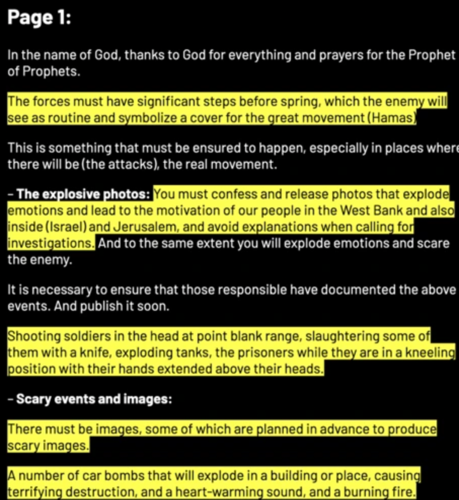
Sinwar Letters (English Translation)
This stands in direct contrast to Hamas’ claim that October 7 was a “legitimate military operation” targeting Israeli forces. It was not.
Denial of Documented Crimes
Hamas asserts that it did not target civilians, journalists, medical personnel, or civilian infrastructure. These claims are contradicted by extensive documentation.
Israeli civilians were deliberately murdered and abducted. Paramedics were killed while attempting to rescue the wounded. Journalists were targeted and killed, including Roy Idan of Ynet News in Kibbutz Kfar Aza. Ambulances were fired upon during evacuation efforts. Hamas operatives have been recorded disguising themselves as civilians and, in some cases, using press markings to conceal combat activity.
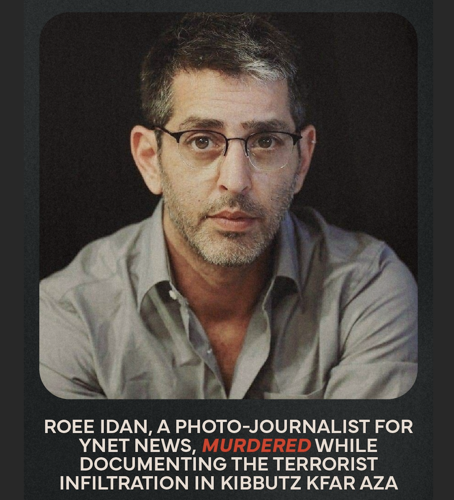
Legitimate military conduct is assessed by behavior on the ground, not by declarations issued after the fact.
The Manipulation of Language
Throughout the document, Hamas relies on linguistic framing to obscure responsibility. Acts of mass murder are described as “operations,” terrorists are labeled “resistance fighters,” and civilian deaths are either ignored or reframed as unavoidable consequences of conflict.
At the same time, Hamas introduces charged terminology, such as “Judaization”, while omitting its own ideological commitment to Israel’s destruction and its close ties to Iran. The document presents Hamas as a victim of international injustice while excluding its own role in initiating violence and embedding itself within civilian environments. The irony is unmistakable.
Hamas and the Exploitation of Civilians
Absent from Hamas’ narrative is any acknowledgment of its systematic use of Gaza’s civilian population for military purposes. For years, Hamas embedded its infrastructure within homes, schools, hospitals, and places of worship. Senior leadership operated from tunnel networks constructed beneath densely populated civilian neighborhoods.
Hamas has publicly acknowledged its use of civilians as human shields. It has diverted humanitarian aid, seized supplies intended for civilians, and exploited international assistance to maintain control over the population. These practices directly endangered civilians and violated international law.
Since the beginning of the war, Israel facilitated the entry of more than two million tons of humanitarian aid into Gaza, while Hamas routinely appropriated and resold that aid for its own purposes.
The Ceasefire and Selective Omission
Following the October 2025 ceasefire, Hamas presented the agreement as a victory and proof of legitimacy. Notably absent from its account was a central condition of the agreement: Gaza is to be rendered a de-radicalized, terror-free zone that no longer poses a threat to Israel or the region.
This omission reflects the broader purpose of the document—to claim moral authority without accepting responsibility.
Furthermore, the document conveniently skips the almost daily ceasefire violations Hamas has been committing, including crossing the eastern side of the Yellow Line, threatening IDF troops, and most significantly, withholding the last remaining hostage, SFC. Ran Gvili.
Actions, Not Declarations
The IDF does not define its legitimacy through documents or slogans. It is defined by conduct.
Throughout the conflict, the IDF implemented measures to reduce civilian harm, including advance warnings to civilians, phone calls, leaflets, and evacuation corridors, often at the expense of tactical surprise. Operations were delayed or canceled when civilian presence was detected. Humanitarian aid, medical supplies, and shelter were facilitated for a population living under Hamas control.
These actions stand in contrast to Hamas’ conduct and demonstrate the difference between declared intent and operational reality.
Hamas’ 42-page document is an attempt to reshape perception through language. It does not alter the facts of October 7 or the conduct that followed.
More than 1,200 people were murdered.
251 were kidnapped.
Civilians were deliberately targeted, in a music festival, in their streets, in their beds.
Truth is not established through carefully edited narratives written for foreign audiences. It is revealed through actions. And the actions of Hamas on October 7 speak for themselves.a
